CO2 Emissions
CO2 or Carbon Dioxide emissions are caused by burning down fossil fuels and these emissions are the main reason for global warming. The Kyoto Protocol, an international treaty adopted in 1997 by many of the parties to the United Nations Framework Convention on Climate Change (UNFCCC), is working towards curbing CO2 emissions globally.
The visual below shows the difference in per capita emissions across the globe from 1960 to 2011.
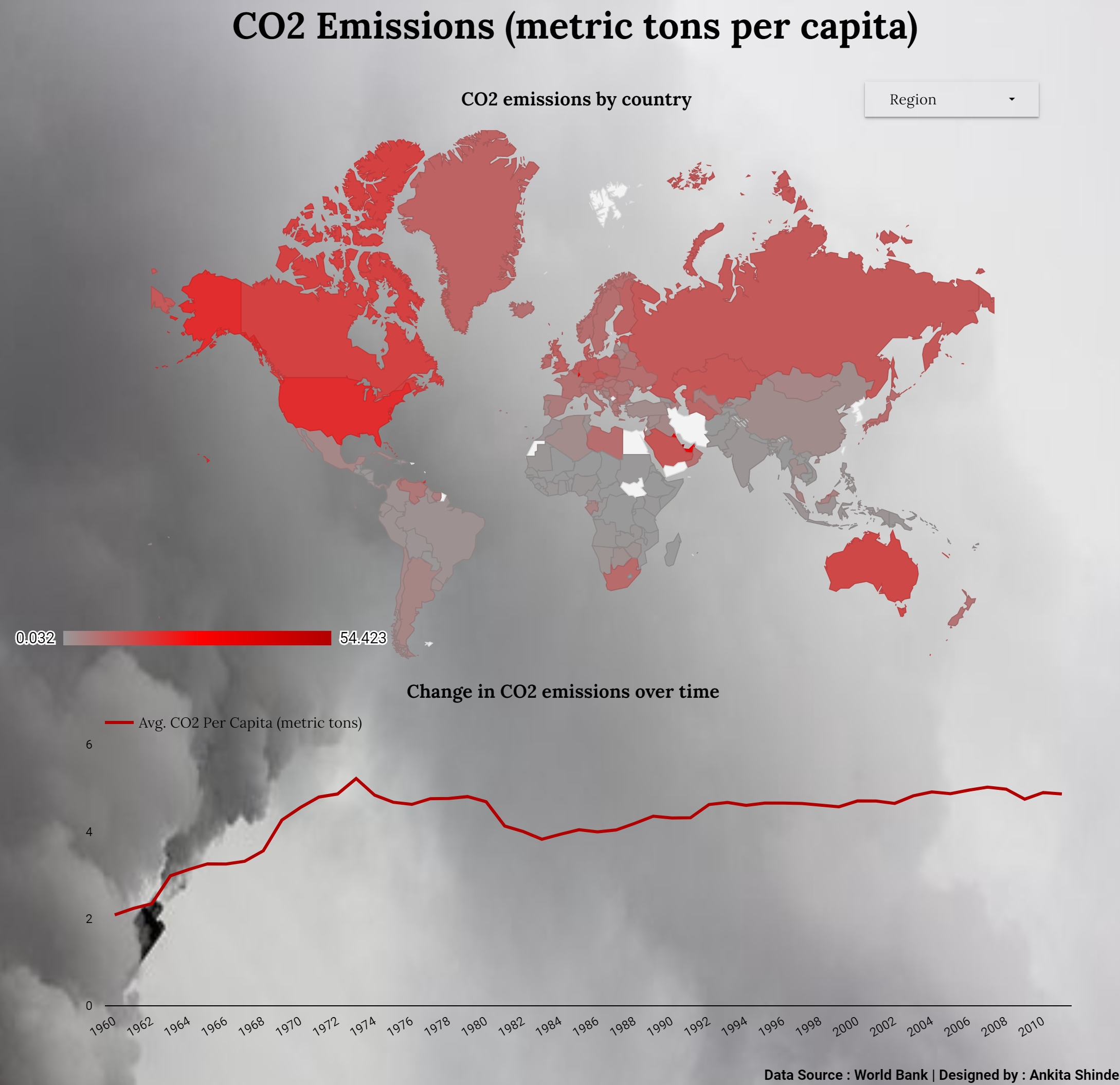
Until 1960, Europe was a major contributor of CO2 emissions. To be precise, half of the world’s cumulative emissions came from the UK alone. Over the century, increased industrialization, oil production, and exponential growth in manufacturing activities in USA, Canada, UAE, Australia, and Russia led to it being the major contributors of CO2 emissions. Developed countries such as US, Canada, and Russia with high population accounted for more than 80% of emissions each year. This is 3 times higher than the global average which in 2010 was 3 tons per person.
In general, developed countries typically have high CO2 emission per capita because:
- Countries with high GDP can afford to use more gasoline and industrial production which causes pollution.
- Countries with high levels of car use lead to more CO2 emissions.
- Burning fossil fuels leads to CO2 emissions. Therefore, countries which gain energy from renewables have lower CO2 emissions per capita.
Note: Only CO2 emissions from fossil fuels and cement production are included in these charts.